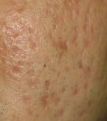
Acne Scar TreatmentWelcome to Acne Scar Treatment website. Find all the information needed on treating acne scars !
Acne scar treatment
Acne treatment is the most common treatment amoung young individuals.
Ance is the most common and chronic skin disorder, where almost 6 out of 10 individuals (between the ages of 12 and 24) suffer from some degree of acne. However, acne can also occur in adults into their 40's.
Acne creates an immense amount of self embarrassment and tends to make an individual look down on themselves creating a self-image and self confindence problem for an individual, especially at a young age.
What is acne?
Acne is a skin disorder that results from active hormones on the sebaceous glands of the skin leads to clogged pores (creating whiteheads and blackheads) and then creates and outbreak of nodules or cysts which are commonly referred to as pimples.
Acne is commonly found on the skin of the following areas:
Although acne is not a life threatening condition, it can sometimes lead to permanent (and sometimes serious) scarring on the skin affected by acne. There are a few topical skin care medications and products that can treat mild acne scarring, however, most scars caused by acne are treated with combined surgical procedures, as well as skin resurfacing.
How do i know that its a scar?
After acne has diminished, either a hyper pigmented or red mark can be left on the skin. These marks are not scar, they are post-inflammatory changes. While the skin is progressing through its healing process (takes between 6 - 12 months), the hyper pigmentation or redness is seen on the skin. The skin can heal normally if no marks develop in that area, however, any skin defect or color change still seen after 1 year is then considered a scar.
How can i treat EARLY acne scars?
The skins natural healing process consists of post-inflammatory changes (caused by acne). There are ways and medications that can benefit with these healing progressions, such as:
Picking scabs is a definite NO-NO. They are there to protect the healing process that takes place underneath them and when you pull a scab off before it it ready, it interferes with the healing process, which causes the post-inflammatory changes to be visible faster.
Wearing a good sunscreen is important simply because unprotected exposure to the sun causes an immense amount of skin damage which delays the healing process.
Appropraite formulations of AHA's (Alpha-Hydroxy Acids) and BHA's (Beta-Hydroxy Acid) that are at the right pH levels and contain the correct concentrations, help the skins healing process.
The use of tretinoin (Renova, Avita, Retin-A) makes the skin's remodeling process faster and helps with the healing of post-inflammatory changes.
Is there only one type of scar?
There are 3 different types of scars that are created from acne. Based entirely on the appearance of the scar, acne scars are classified as icepick, boxcar and rolling.
How do i know which scar type it is?

Icepick Acne Scars:
These scars' appearance is sharp and narrow, portraying your skin has
been punctured with an icepick. Usually extending into the subcutaneous
or dermis layer and over 2mm narrow. Skin resurfacing treatment, such as
laser resurfacing or dermabrasion is not likely due to the fact that
these scars are normally too deep to fix
Boxcar Acne Scars:
These scars are round - oval depressions with vertical edges that are
sharp. These scars do not form a point at the base of the scar, unlike
icepick scars and they can either be classified as shallow boxcar scars
or deep boxcar scars. Shallow boxcar scars are between 0.1mm - 0.5mm
deep and requires treatment using the techniques of conventional skin
resurfacing. Deep boxcar scars are deeper than 0.5mm and the techniques
of full-thickness treatment is required.
Rolling Acne Scars:
These scars form as a result of tethering on what appears to be normal
skin to the subcutaneous tissue below, which gives the skin the
appearance of rolling or undulating. The techniques of conventional skin
resurfacing doesn't work on rolling scars, but must be corrected by a
method of breaking up the subcutaneous fibrous bands.
What procedures are there to correct scars?
There are a few procedures that can be done in order to correct
scarring. They normally combined several procedures in order to create
the smoothest appearing skin. Keeping in mind that each procedure has
its own individual benefits and risks.
Punch Elevation:
Usually used to correct deep boxcar scars with normal appearing basis
and sharp edges. A punch tool is used in order to excise the base of the
scar resulting in the walls of the scar being in contact with each
other. The base that is excised is then lifted to the surface of the
skin where it is attached with steri-strips, sutures or skin glue
(Dermabond). This specific method reduces the risk of texture or color
differences that can be seen with graft replacement, as well as reducing
the risk of a visible scar being produced when wound edges are
saturated.
Punch Excision with Skin Graft Replacement:
A punch tool excises the scar in this method. A punch skin graft that is
usually taken from behind the ear, fills the defect, instead of the
skin edges behind sutured together. A color and texture difference may be
noticed in this procedure, although 4 - 6 weeks after the grafting, a
skin technique can be used in order to correct the difference.
Dermal Fillers:
In order for the surface of the skin to be raised and given a smoother
look, there are many types of dermal fillers that can be injected into
acne scars. Examples of dermal fillers - Fat, human collagen, bovine
collagen, polytheyl-methacrylate microspheres with collagen and
hyaluronic acid derivatives. Further injections are needed due to the
fact that the injection of these materials don't correct the acne scars
permanently.
Subcutaneous Incision:
Also referred to as 'Subcision', it has the risk of causing bleeding and
the formation of subcutaneous nodules. With proper use of anesthetics
and bandaging, the bleeding can be controlled and the subcutaneous
nodules can be treated with corticosteroids being injected into the
nodule. This method breaks up the fibre bands that cause rolling scars.
This method is done under local anesthesia. A specially beveled needle
is inserted under the skin in order for it to be parallel to the skin
surface. The needle is advanced and retracted in a piston-like motion
gently, cutting the tethering glands, while staying in the area between
the subcutaneous tissue and the dermis. Bruising is caused by this
procedure, which fades away after about a week.
Laser Resurfacing:
This procedure is popular for treating many skin defects and is used by
the most popular of laser types used for resurfacing acne scars, these
lasers are know as the C02 (Carbon Dioxide) and Er.YAG (Erbium:YAG). The
lasers burn the top layers of the skin to a specific depth essentially.
The burning layers of the skin are then replaced by the new skin during
the healing process. In order to determine the success of the
procedure, it is very important to have the correct post-operative care
of the skin that has undergone the laser resurfacing.
Punch Excision:
Used on correcting deep scars (icepick and deep boxcar scars), this
procedure consists of a puch biopsy tool. A punch biopsy tool is a round,
sharp tool (Like a cookie-cutter) that has a diameter range from 1.5mm -
3.5mm. Depending on the size of the scar, the size of the tool is
matched by that, in order to include the walls of the scar. The scar is
excised with the puch tool and the skin edges are sutured together,
while under a local anesthesia. There will be a new scar that is
produced, due to the operation but it fades and is no longer noticable.
If, however, it is noticable it is easy to rid due to the new
resurfacing techniques.
|